
A student finishing their 9th grade who enjoys arranging spaces, choosing colors, or drawing room plans finds themselves at a concrete crossroads: the path chosen now determines the training accessible after high school. Directing their wishes towards interior decoration does not go through a single pathway, and some options are decided well before high school.
9th grade pre-professional: an unknown option to anticipate as early as 8th grade
Interior decoration is rarely thought of when discussing 9th grade pre-professional. This class, requested at the end of 8th grade, allows students already oriented towards a vocational pathway to discover several sectors (building, finishing, layout) while following the diploma program.
The direct advantage: a priority for placement in vocational training at the end of 9th grade. A student aiming for a CAP or a vocational baccalaureate related to layout or furniture thus secures their orientation without closing off the general or technological pathway.
By choosing studies after 9th grade to become an interior decorator, it is noted that this bridge remains underutilized by families aiming for careers in space design.
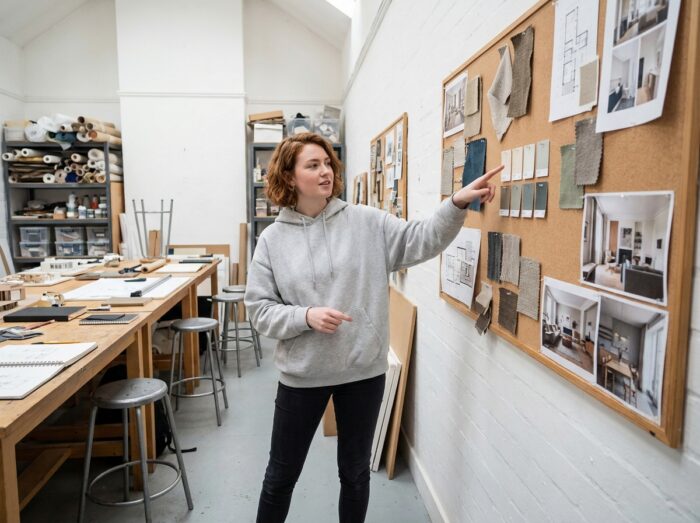
CAP and vocational baccalaureate in layout: the practical path after 9th grade
The classic reflex is to look for a general or technological baccalaureate. It is forgotten that two professional diplomas prepare directly for the technical gestures of interior decoration.
The CAP in two years: quickly entering the practical
The CAP (carpenter manufacturer, painter applicator of coatings, for example) trains in materials, finishes, and reading plans. Apprenticeship is possible right after 9th grade, provided the student is at least 16 years old by December 31 of the year they enter training.
This pathway remains a springboard. A CAP is not enough to work as an interior decorator, but it provides knowledge of materials and installation techniques that many graduates from higher schools lack.
The vocational baccalaureate in architectural space layout
The vocational baccalaureate in architectural space layout is prepared in three years after 9th grade. It covers the creation of plans, project management, and coordination with construction trades.
This diploma then opens access to a BTS Study and realization of layout or a DN MADE (national diploma of arts and design professions), mention space. Feedback varies on the ease of this transition, as places in DN MADE remain limited and vocational baccalaureate applications compete with those from general baccalaureate or STD2A.
STD2A Baccalaureate: the technological pathway designed for design
For a student who prefers to remain in the general or technological pathway, the STD2A baccalaureate (sciences and technologies of design and applied arts) is the most directly oriented course towards interior decoration.
Here is what distinguishes it from other baccalaureates:
- An integrated design and applied arts education starting from 10th grade, with concrete space layout projects
- Facilitated access to the DN MADE mention space or to the BTS Design of space, without going through a year of leveling
- A technical culture of materials, volumes, and color that prepares for specialized post-baccalaureate schools
The number of high schools offering the STD2A baccalaureate remains limited. It often requires considering a boarding school or a change of establishment, which deters some families.
Alternative: the general baccalaureate with arts specialty
A general baccalaureate with a specialty in visual arts keeps doors open. The student will then need to enroll in a DN MADE in three years to access higher education in space design. The pathway is longer, but it allows the possibility of shifting towards interior architecture (level bac+5) if the project evolves.

Post-baccalaureate training leading to the profession of interior decorator
The choice made in 9th grade makes perfect sense when applying for higher education programs. Three courses consistently appear in the paths of active professionals:
- The BTS Study and realization of layout (bac+2), accessible after a vocational baccalaureate in layout or an STD2A baccalaureate, which trains in the technical management of layout projects
- The DN MADE mention space (bac+3), which combines design, project, and artistic culture
- Private schools specializing in interior decoration, which award certified titles (bachelor in space design, for example) in three or four years, often accessible without artistic prerequisites but with high tuition fees
Alternating work-study programs provide a concrete lever to finance these trainings and gain practical experience. They are offered in several BTS programs and in some private schools, allowing students to work in a decoration agency or with a craftsman from the first year post-baccalaureate.
What makes the difference in the field
A diploma alone is not enough to attract clients or secure a salaried position. Interior decorators who establish themselves sustainably generally combine technical training (materials, reading plans, design software) with an aesthetic sensitivity developed through practice.
Building a personal portfolio as early as high school, even with fictional projects or rearrangements done for relatives, provides a measurable advantage when applying to schools or internships. Admission juries for DN MADE or specialized schools evaluate the project approach as much as the drawing level.
The profession of interior decorator does not require a protected diploma (unlike that of interior architect, which has a recognized title). A solid training in layout, materials, and space design remains the best foundation to practice credibly, whether one chooses employment in an agency or independent status.