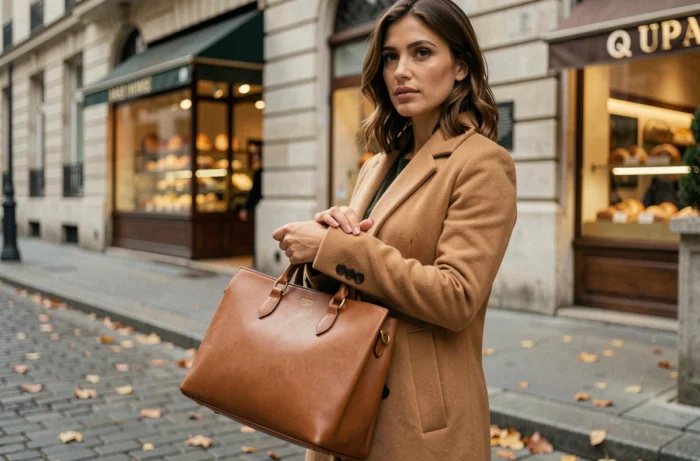
Fashion accessories refer to all the pieces added to an outfit to alter its visual perception: bags, belts, scarves, jewelry, shoes, glasses. Their function goes beyond decoration. They restructure a silhouette, introduce a contrast of textures or colors, and direct the gaze towards a specific area of the body. Understanding their mechanics allows for the composition of coherent outfits without multiplying clothing items.
Structural function of accessories on the silhouette
An accessory affects the perception of body proportions. A belt worn at the natural waist creates a visual break between the bust and hips, which visually shortens the torso and elongates the legs. When placed lower, on the hips, it produces the opposite effect.
The same principle applies to bags. A bag worn with a short strap draws attention to the upper body. A handbag held at hip level visually widens that area. The choice of size also matters: a bulky bag on a slender silhouette flattens proportions, while a clutch on a broad frame can appear unbalanced.
Scarves play a comparable role at the neck and décolletage. Tied near the collar, a scarf shortens the perceived neck. Left long on an open dress, it elongates the vertical line of the bust. These catalogs of pieces and their effects on the silhouette are detailed on accessoiresmode.fr, making concrete associations easier.
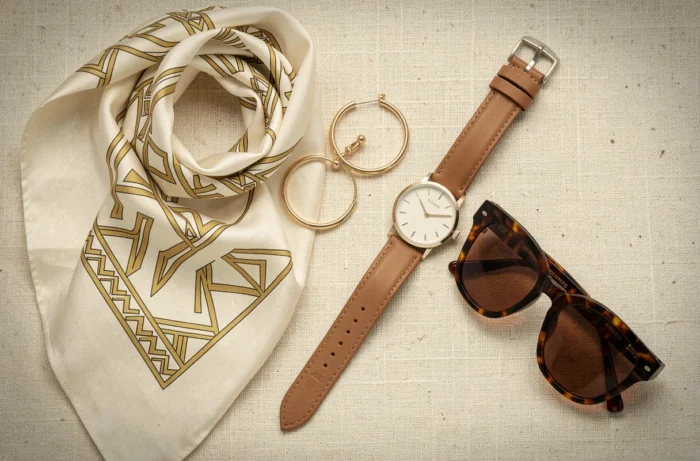
Contrast of textures and colors: the mechanics of a successful look
The addition of an accessory modifies the texture palette of an outfit. Wearing a brushed metal bracelet over a knit sleeve creates a tactile contrast that enriches the ensemble without adding extra clothing. Pairing a textured leather bag with a satin dress introduces a matte/shiny opposition that structures the gaze.
The principle also works with colors. On a monochrome outfit (tonal beige, all black, off-white), a single accessory in a bold color is enough to create a focal point. This is the logic of the single color point: a red belt on a gray outfit, gold earrings on a navy sweater.
Common mistake: overloading contrasts
Multiplying textures and colors in accessories produces the opposite effect. Three different metals (gold, silver, copper), a printed scarf, and a two-tone bag create visual dispersion. The gaze no longer knows where to settle. The most reliable operational rule remains to limit accessories to two or three pieces coordinated by a common element (same metal, same color family, same material category).
Fashion accessories and circularity: what the European regulation changes
Since July 2026, the European Union prohibits large companies from destroying their unsold clothing, shoes, and accessories. This measure, often overlooked in style guides, alters the availability and even the design of the pieces offered in stores.
Brands must now donate, repair, resell, or recycle their stock rather than dispose of it. The direct consequence for buyers: a growing offer of second-hand accessories in good condition, often from recent collections, available at reduced prices on resale platforms.
The regulatory framework goes further. Medium-sized companies will have to comply with these transparency obligations regarding destroyed volumes by 2030. The system of extended producer responsibility also imposes eco-contributions adjusted according to the sustainability and recyclability of products. Accessories made from recyclable or sustainable materials benefit from lower contributions, encouraging brands to reconsider their material choices.
Consequences on material choices
This regulatory pressure favors accessories made from natural, recycled, or certified materials. Vegetable-tanned leather, bio-sourced acetate for eyewear frames, recycled metals for jewelry are gaining ground. For consumers, this translates into pieces that are often denser, better finished, but whose entry price may increase.

Shoes and belt: the two pieces that anchor an outfit
Among all accessories, shoes and the belt exert the strongest influence on the overall look. Shoes define posture, gait, and leg line. The belt, in turn, establishes the central reading point of the outfit.
A principle of coordination remains relevant without being rigid:
- Harmonizing the color of the belt and shoes creates immediate coherence, suitable for formal or structured outfits
- Playing with deliberate contrast (light belt, dark shoes) works on casual outfits as long as the rest of the outfit remains understated
- Choosing shoes with a heel height that matches the cut of the pants or dress avoids disproportions (a wide pant requires a heel or thick sole to avoid dragging on the ground)
The belt does not need to be visible to act. A thin belt under a blazer structures the fall of the fabric without appearing, which refines the perceived waist while maintaining a clean look.
Building a versatile accessory kit
Accumulating trendy accessories each season ends up producing a drawer full of unused pieces. The reverse approach works better: building a small core of compatible pieces.
- A medium-sized bag in a neutral color (black, cognac, taupe) that adapts to most everyday outfits
- A pair of discreet earrings in a single metal, wearable both at the office and in the evening
- A scarf in a fluid fabric (silk, modal) in a sober print that serves as a touch of color or protection against light cold
- A well-made leather belt, neither too wide nor too thin, compatible with jeans, dresses, and dress pants
Four or five well-chosen pieces cover the majority of dressing situations. Adding a seasonal piece (sunglasses in summer, hat in winter) is enough to refresh the style without cluttering the wardrobe.
The most effective accessory is the one that serves two functions: aesthetic and practical. A bag that structures a look while containing what one needs daily, a belt that adjusts a garment while creating a visual point. It is this dual utility that distinguishes a relevant accessory from an impulse purchase.