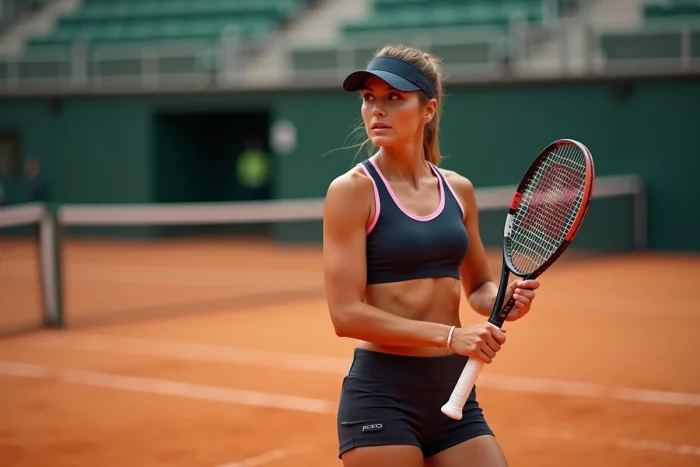
Aryna Sabalenka, the world number one, has posted a series of topless photos on her social media, triggering a wave of reactions that extend far beyond the realm of tennis. This episode raises an age-old question from a renewed perspective: who decides how a female athlete’s body is portrayed, and under what conditions does this exposure fall under personal choice rather than media imposition.
Image Charters in Women’s Sports: A Framework Under Construction
Before discussing freedom or provocation, one fact deserves to be stated. Since this episode, several federations and women’s leagues have been explicitly working on charters for the use of female athletes’ images. These documents distinguish individual freedom (personal publications on Instagram, fashion collaborations) from content used by clubs and sponsors.
The central principle of these charters is based on systematic written validation and the possibility of withdrawing consent afterwards. In other words, an athlete can authorize the use of a photo in a specific context and then retract that authorization if the circumstances change. This nuance seems to have concrete effects on how commercial partnerships frame photo shoots, as the topless photos of Aryna Sabalenka have accelerated this awareness within several organizations.
However, this framework remains fragmented. Each federation progresses at its own pace, and national leagues do not all share the same definition of what falls under private life or the institutional image of a female athlete.
Right to Muscle and Female Bodies in Sports: What Sports Sociology Documents
Sabalenka’s gesture is part of a broader movement documented by researchers in sports sociology. Sociologist Florys Castan-Vicente describes access to muscle as still “complicated” for female athletes, despite an underlying trend to claim a performing body rather than a sellable one.
The paradox is well-known: an athlete is expected to be powerful on the field, but media codes continue to value a female body calibrated according to narrow aesthetic criteria. Fit but not too muscular, visible but not overly exposed. This tension runs through all disciplines, from tennis to athletics.
The Demand for an “Acceptable” Body in Women’s Sports
The debate surrounding Sabalenka precisely crystallizes this contradiction. Reactions oscillate between two poles:
- Those who see toplessness as a form of emancipation, an act of reclaiming the body by the athlete herself, outside the gaze of federations or sponsors
- Those who interpret it as a reproduction of fashion and marketing codes, where the female body remains a visibility argument before being a tool for performance
- A third reading, less publicized, which highlights the gap between the freedom displayed on social media and the clothing constraints still in place in certain official competitions
The available data does not allow for a definitive conclusion between these interpretations. They coexist, and it is precisely this coexistence that makes the subject so difficult to reduce to a slogan.
Gender Testing at the 2028 Olympics: The Control of Female Bodies Returns to the Forefront
In March 2026, IOC President Kirsty Coventry announced the return of so-called “femininity” genetic tests for all women’s sports at the 2028 Olympic Games. Presented as a tool for protecting female categories, these tests abruptly reposition the debate on who has the right to compete in women’s sports.
The timing is not trivial. At the very moment when Sabalenka’s toplessness reignites the question of voluntary body exposure, the IOC reintroduces a biological control mechanism that touches on the very identity of athletes. The two subjects do not address the same issue, but they share a common point: the governance of the female body in sports remains a terrain of unresolved tensions.
The French Case: A Legal Ban Creating a Gap
In France, these femininity tests remain legally prohibited on national territory. This situation creates a concrete gap for French athletes participating in international competitions where these tests would be applied. The question of how French federations will manage this contradiction has not yet found a public answer.
Social Media and the Media Portrait of Female Athletes: Where is the Line?
The Sabalenka episode also highlights the role of social media in shaping the public portrait of an athlete. On Instagram, the Belarusian player controls her own image, chooses her angles, captions, and style. This editorial autonomy contrasts with traditional media treatment, where photos of female athletes are often selected based on criteria that escape the main interested parties.
The difference is structural. On a personal account, the athlete decides. In a press article or a sponsored campaign, it is third parties who choose which image will serve the narrative. The image charters currently being developed aim to bridge this gap by giving athletes a contractual right to oversee the use of their image outside their own pages.
Image Politics and Athlete Autonomy
The word “politics” is not exaggerated here. The way a female athlete chooses to show her body is an act of positioning in a public space still largely governed by male perspectives and commercial interests. By publishing these photos, Sabalenka is not just posing; she asserts a form of sovereignty over her own image in a world where this sovereignty is rarely achieved.
Field feedback diverges on this point. Some high-level athletes praise this displayed freedom, while others believe it inadvertently reinforces the idea that a female athlete’s visibility comes through the exposure of her body rather than her results. Both positions are based on lived experiences, and neither can be dismissed.
The debate surrounding Aryna Sabalenka will not close with a consensus. It adds to a series of structural tensions in women’s sports, between individual freedom, institutional frameworks, and commercial pressure. The next step will likely take place less on social media than in the offices of federations, where image charters and dress regulations are negotiated away from the cameras.