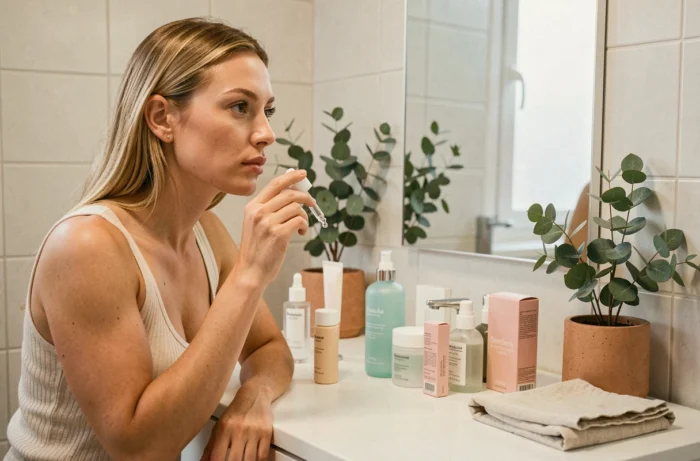
The French cosmetic market is undergoing a year of massive reformulations. The implementation of new European regulations on packaging, the ban on PFAS, and the expansion of the list of fragrance allergens are reshaping the formulas, packaging, and labels of beauty products sold in France.
Ban on PFAS and Reformulation of Cosmetics in France
Law No. 2025-188 prohibits the manufacture, import, export, and marketing of PFAS in cosmetics. These per- and polyfluoroalkyl substances were used for their film-forming effect, water resistance, and ability to enhance long-lasting wear.
The most affected categories are waterproof foundations, long-wear mascaras, and certain sunscreens. Brands must reformulate without simply removing an ingredient: the functional replacement of a PFAS often requires a complete overhaul of the product matrix.
This regulatory constraint is also driving the French market for solid cosmetics. Anhydrous formulas, which do not require synthetic film-formers or complex preservatives, are gaining ground as a credible alternative. To keep up with beauty news on Annuaire Beauté, this regulatory transition remains the main theme of the back-to-school season.
European Regulation on Cosmetic Packaging: What Changes in August 2026
Regulation (EU) 2025/40 will be applicable from August 12, 2026. It imposes new sustainability and labeling requirements on all packaging placed on the European market, including that of beauty products.
Specifically, three obligations structure this text:
- Recyclable design becomes the norm: non-separable multi-layer packaging (such as airless pumps with metal springs) will need to be rethought
- The reduction of unnecessary packaging applies to decorative overpackaging, which is common in the premium segment and gift sets
- The standardization of environmental information on packaging requires a readable and harmonized format at the European level
For French brands, the impact affects both design and the supply chain. Colored glass bottles, refills, and solid formats mechanically meet these requirements.
Fragrance Allergens and New INCI Lists: Reading Labels Differently
The European Union has expanded the list of fragrance allergens that must be declared on cosmetic packaging. INCI lists are becoming longer and more detailed, which concretely changes how sensitive consumers choose their products.
Until now, regulations required the mention of about twenty allergens. The expansion adds new molecules, forcing brands to audit each scented formula. A face serum containing a fragrance, even a subtle one, now displays a significantly longer ingredient list.

This change fosters two dynamics. Brands that already work without added fragrance highlight this argument. Those that scent their products are investing in simpler olfactory compositions, with fewer allergenic molecules, to maintain a short and reassuring INCI list.
Trending Actives: PDRN, Peptides, and Ectoine in Face Care
In terms of formulation, the star actives of the season largely come from K-Beauty. PDRN (polydesoxyribonucleotide) is a salmon-derived active used in Korean regenerative medicine, now appearing in mainstream serums. Its action targets cellular regeneration and strengthening the skin barrier.
Peptides continue to rise in popularity in anti-aging treatments. Unlike retinol, they rarely cause irritation, making them compatible with sensitive skin and minimalist routines.
Ectoine, a molecule produced by extremophilic microorganisms, protects cells from environmental stress. It is incorporated into moisturizers and serums as a protective active complementing classic antioxidants.
These three actives share a common point: they strengthen the skin barrier rather than exfoliate or stimulate renewal. The dominant paradigm in skincare is shifting from “treating” to “protecting.”
Makeup and Fragrance: The Formats That Are Progressing the Most
In makeup, tubing mascara is becoming more mainstream. Its polymer-based formula removes easily with warm water without oily makeup remover, simplifying the evening routine. Several brands now offer their version at an accessible price.
Lip inks and lip serums show marked research progress. The lip serum combines moisturizing care with light color, sitting somewhere between balm and gloss, without the sticky finish.
On the fragrance side, gourmand eaux de parfum and oud fragrances continue to drive growth in the segment. Notes of vanilla, caramel, and oud wood appeal to a generation that views fragrance as both an identity accessory and a sensory experience.
Beauty in 2026 is defined less by its launches and more by its constraints. The ban on PFAS, the packaging regulation, and the expansion of allergens are reshaping the formulas available on the shelves. The trendy actives, from PDRN to ectoine, are part of a fundamental movement: to protect the skin rather than transform it. Brands that anticipate these regulatory changes gain an advantage over those that merely follow formulation trends.