
Installing a curtain in front of a front door may seem simple, but the result depends less on the chosen fabric than on the installation method and the condition of the door itself. Before fixing a rod, one must know what is expected from the curtain: to hide an unsightly door, block a draft, or gain privacy. Each goal points towards a different type of fabric, fixing system, and precautions.
Fabric for the front door curtain: comparison of materials
The choice of fabric determines both the visual effect and the function of the curtain. Not all materials are equal depending on the intended use.
| Fabric | Thermal insulation | Sound attenuation | Maintenance | Decorative effect |
|---|---|---|---|---|
| Thick velvet | Very good | Good | Dry cleaning recommended | Luxurious appearance, deep colors (black, burgundy) |
| Double cotton | Good (with padded lining) | Average | Machine washable | Wide choice of colors and patterns |
| Thick linen | Average | Low | Washable, lightly wrinkled naturally | Natural style, neutral tones |
| Technical thermal fabric | Very good | Average to good | Washable, quick drying | Sober appearance, limited decorative choice |
Velvet and double padded cotton are the top choices for blocking drafts around the door. Linen, appreciated in decor, allows more cold air to pass through and is better suited for doors that are already well insulated. Technical thermal fabrics offer good performance but a limited color selection.
Installing a curtain to hide an unsightly door leans more towards printed cotton or velvet, which dress up the entry space while concealing a reinforced door or a damaged leaf.
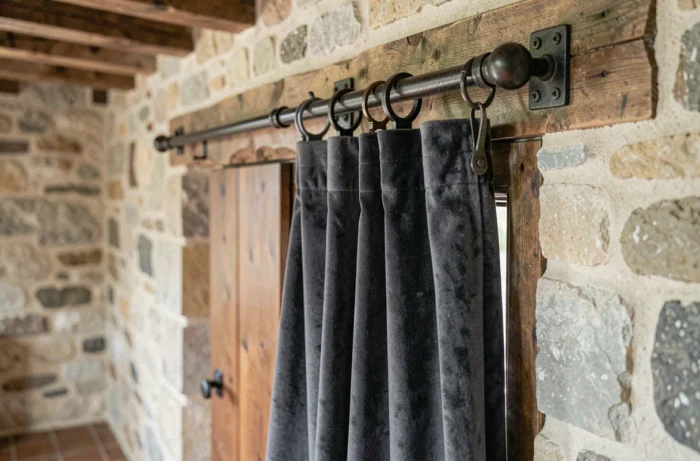
Rod and fixing: what makes the difference in installation
The rod is the technical point that most guides overlook. Yet it is what determines whether the curtain fulfills its function or floats uselessly in front of the door.
Wall-mounted rod above the door
This is the most common solution. The rod is fixed to the wall, about fifteen centimeters above the door frame. It must extend at least ten centimeters on each side of the frame so that the curtain covers the side areas where cold air seeps in.
The curtain ideally descends to the floor. A fabric that stops halfway does not block the cold or the view.
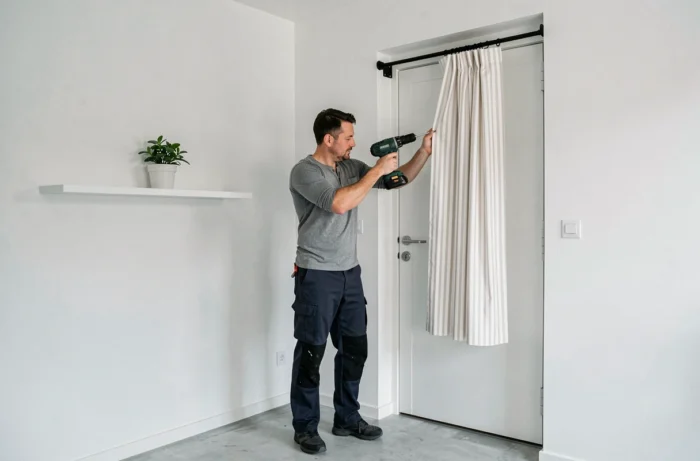
Door rod fixed to the leaf
This special rod screws directly onto the door. The curtain moves with the leaf each time it opens and closes. This system is suitable when one cannot drill into the wall (rental, fragile walls) or when the door is recessed in a nook that prevents wall mounting.
However, the curtain fixed to the door does not cover the frame or the side joints. Thermal insulation is therefore less effective than with a wall-mounted rod.
Criteria for choosing the fixing
- Load-bearing wall or partition: a plasterboard partition requires suitable anchors, or else the rod may pull out under the weight of thick velvet
- Tenant or owner: the door rod screwed onto the leaf can be removed without leaving marks on the walls, simplifying the return of the rental
- Frequency of door opening: a front door used dozens of times a day does not handle a heavy curtain on a door rod well, which eventually tires the hinges
Check the door’s airtightness before installing the curtain
A curtain, even a thick one, remains a complement. It does not correct a defect in the door’s airtightness itself. Several recent sources emphasize this point: a curtain can hide an air or water leak and promote condensation between the fabric and the door.
Before installation, two simple checks can identify a problem. Slowly run your hand along the joints of the frame to identify areas where air passes. Slide a piece of paper under the closed door, then pull: if the paper comes out without resistance, the threshold is no longer doing its job.
Worn seals or a damaged threshold can be replaced for a few euros at a hardware store. This preliminary step makes the curtain much more effective, as it no longer has to compensate for a structural defect.
Interior curtain and summer heat: a limit to know
In winter, a thick curtain in front of the front door reduces the feeling of draft and keeps the heat in the entry space. In summer, the logic reverses. A curtain placed on the inside comes into play after the heat has already crossed the door. An exterior protection blocks radiation before it enters, making it significantly more effective against overheating.
For a glass or semi-glass door exposed to the sun, the interior curtain is not sufficient to cool the entry. It is better to consider an exterior blind or a solar film on the glazing as a complement.
Risk of humidity between the door and the curtain
In a poorly ventilated entry, a curtain kept closed at all times creates a confined space between the fabric and the door. If the door is exposed to rain or if the threshold allows moisture to pass through, condensation can form in this enclosed space.
To avoid this phenomenon:
- Lift or pull back the curtain a few hours a day, especially in humid weather, to renew the air in this area
- Regularly check the bottom of the door and the floor for signs of moisture or budding mold
- Choose a fabric that does not retain water: washable cotton dries faster than velvet, which absorbs and retains moisture
A well-installed front door curtain, on a properly sized rod, with fabric suitable for the use and a door with good seals, truly transforms the comfort of an entry. The trap would be to consider the curtain as a standalone solution: it works in conjunction with an airtight door, not in place of it.