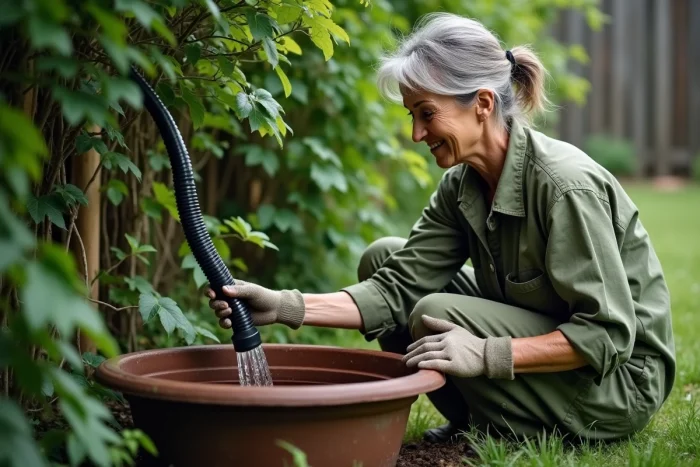
Collecting rainwater without a roof or gutter in a garden is based on a simple principle: artificially creating a catchment surface directed towards a collection point. The techniques vary depending on the available surface, wind exposure, and regulatory constraints related to water stagnation.
Sizing the Ground Catchment Area
The performance of a system without a roof directly depends on the catchment area exposed to the rain. A stretched tarp of a few square meters is sufficient to supply supplementary watering, but the yield drops as soon as the inclination or tension of the material is not properly calibrated.
A minimum slope of 5% towards the collection point prevents water retention in the dips of the tarp. A sufficiently dense weight (woven polyethylene or EPDM tarp) resists UV and limits seasonal degradation. Lightweight camping tarps, sometimes repurposed for this use, lose their waterproofing after a few months of permanent exposure.
The connection between the tarp and the storage container is made through a rigid funnel or a simple channel fold leading to the opening of the barrel. Le Jardinier Décorateur’s solutions detail several setups suitable for gardens without shelter and serve as a good starting point for choosing between a fixed structure and a removable structure.
The choice between stakes planted in the ground and a freestanding structure (like a tent without side fabric) depends on the prevailing wind. In exposed areas, short guy lines and ground pegs stabilize the tarp much better than a simple elevated frame.
Fog Nets and Technical Textiles: Capturing Beyond Rain
Fog nets, inspired by devices used in Chile and Morocco to supply communities with water, are beginning to find domestic applications in Europe. The principle relies on micro-textured fabrics stretched vertically that intercept droplets suspended in humid air, mist, and dew, then direct them by gravity to a low reservoir.
This type of vertical capture has a clear advantage in sloped or very windy gardens, where a horizontal tarp loses some water due to splashing. The mesh of the net allows wind to pass while retaining micro-droplets, which reduces wind catch compared to a solid surface.
Installation requires two sturdy posts (treated wood, galvanized steel) and a tension wire at the top. The net must remain taut at all times to maintain its capture efficiency. Fog collection complements rain but does not replace it: in regions where fog events are frequent (Atlantic coast, valley bottoms), the additional yield is significant. In dry continental climates, the contribution remains marginal.
Buried or Above-Ground Storage: What Container Without Gutter Connection
Without a downspout, the choice of storage container leans towards open or semi-open tanks, which poses a direct health problem.
Vector Risk and Cover Requirement
Since the increase in indigenous dengue cases in metropolitan France, regional health agencies have intensified controls on open stagnant water reservoirs. Any tank, barrel, or basin left uncovered or without fine mesh becomes a breeding site for the tiger mosquito.
- Cover each container with a mesh of less than one millimeter, secured with an elastic or a band, to prevent breeding while allowing rainwater to enter.
- Completely empty unused containers at least once a week, as the larval cycle of the tiger mosquito can complete in a few days during warm weather.
- Prefer closed tanks with an overflow connected to a drain or infiltration area to avoid any stagnant overflow around the container.
A food-grade recovery barrel (olive, juice) makes a good supplementary reservoir as long as a calibrated opening is made at the top and the mosquito net is attached.
Buried Tank Without Roof Connection
An underground tank fed by a network of ditches dug in the ground captures surface runoff during heavy rains. The sizing depends on the soil type: clayey ground generates a lot of runoff, while sandy soil absorbs water before it reaches the tank. A filtering well upstream of the tank retains plant debris and limits clogging.

Removable Collection Kits: Mobile Micro-Recovery
Kits originally designed for camping and survival are now repurposed for shared gardens and unprotected plots. The principle: a self-tensioning fabric funnel planted directly into the ground, connected to a jerrycan or soft barrel by a short hose.
These systems can be set up in a few minutes and require no permanent anchoring, making them suitable for family gardens where fixed installations are sometimes prohibited by internal regulations. The catchment area remains modest (rarely more than one square meter), but the cumulative collection over a season covers a significant portion of the watering needs of a small vegetable garden.
- Ensure that the fabric is treated with anti-UV to withstand prolonged exposure between April and October.
- Connect the downspout hose to the barrel with a watertight seal to prevent losses at the connection point.
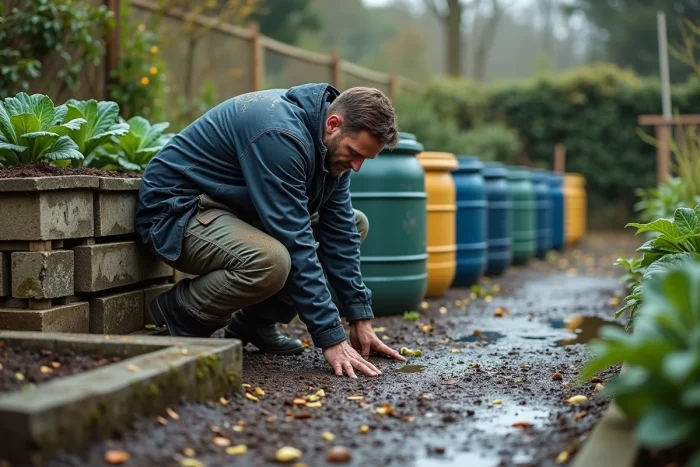
- Elevate the barrel a few centimeters on cinder blocks to facilitate gravity withdrawal via a low tap.
The main drawback of these kits is their low resistance to wind. In gusts, the funnel can turn inside out if the pegs are not driven into sufficiently loose soil.
Collecting rainwater without a roof requires compensating for the lack of a hard surface with a setup suited to the terrain and local climate. The combination of an inclined tarp for rainy episodes and a vertical net for misty periods covers a broader weather spectrum than a single device. The critical point remains the mosquito-proof cover of each container, a non-negotiable health requirement regardless of the size of the installation.